Orwell Astronomical Society (Ipswich)
Comet C/2025 K1 (ATLAS), 18 November - 13 December 2025
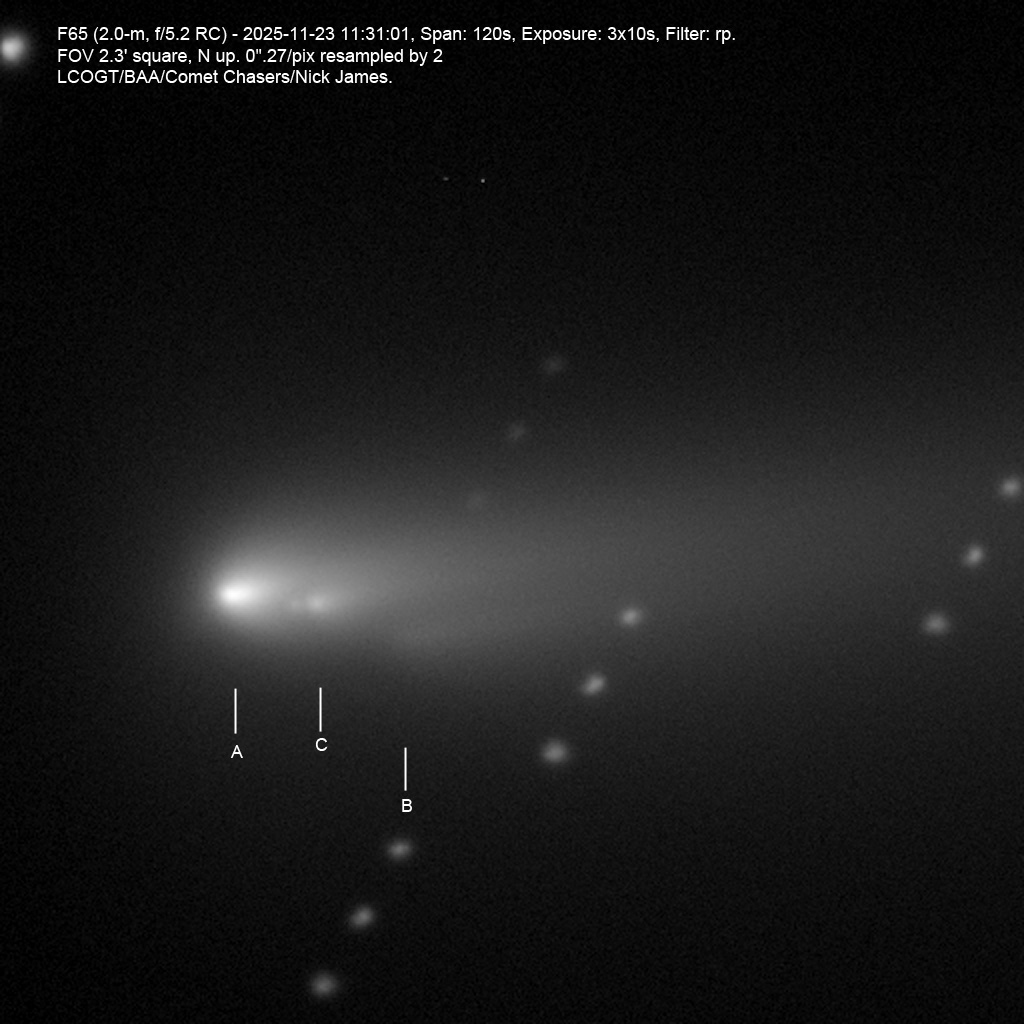
Comet C/2025 K1 (ATLAS) was discovered on 24 May 2025 by the Asteroid Terrestrial-impact Last Alert System (ATLAS). It has come directly from the Oort cloud. Perihelion was relatively close to the Sun (0.3 AU) and the comet was not expected to survive perihelion passage; it did, however, and became visible again in mid-October. By mid-November, the comet was visible in Ursa Major and the nucleus had broken into three fragments, designated L→R A, C, B in the images below.
The comet was travelling through the sky at some 9" per minute, forcing the use of short exposures to avoid blurring detail. The image below shows the three components of the nucleus. Components A and B are approximately 12.4" apart.
I awoke at 4.00am to find a clear sky. It was cold and the main mirror and corrector plate of my telescope were both covered with a layer of condensation.
The image and video below show the three components of the nucleus. The separation of Components A and B is approximately 17.1", an increase of almost 5" since the time of my last observation, two days ago. Ccomponent C has faded and now all three are similar in brightness.

The comet is at high altitude in the early morning and continues to show interesting developments. Components A and B are now approximately 19.1" apart. Yesterday (see above) the three were of very similar brightness but today Component C appears fainter than the others.

The following video shows the motion of the comet across the sky.
Three days on from my last observation and Component B has vanished (rather than Component C, which might have been expected to disappear). A larger telescope can reveal more detail and, for example, the image by Nick James shows a fourth, faint component lurking between A and C; it is byond my reach.

The image below, taken 05:18-05:41 UT, shows components A and C more clearly than the above image.

The image below, taken approximately 18 hours later, is similar to the above. It appears that Component C is fading and may not be visible for much longer. The comet is now circumpolar, so can be observed at much more sociable times!

I normally run my camera in 3x3 binning mode to give a resolution of just over 1 arcsec per pixel - good enough for my purposes. I use 1x1 mode only for focussing (as it oversamples the image). Tonight, after focussing I forgot to change the resolution so collected a series of images at full resolution - each frame was 120MB in size! When I discovered the mistake, as the weather was still holding, I repeated the exercise at 3x3 resolution. This required also capturing two sets of flat frames and a set of dark frames for the 1x1 resolution images, as I did not have any in the library.
The following images show the changing face of the comet, revealing the nucleus with one indistinct companion. The top image of the pair is at 3x3 binning, and the lower at 1x1. Full resolution does not appear to show greater detail, however the companion does appear to be more distinct.


The forecast for the evening was not good. However, after a cloud bank blew over, the sky remained perfectly clear providing an observing opportunity. I imaged the comet again at 3x3 and at 1x1 binning. For the 1x1 binning, I used smaller sub-frames. The results are below: 3x3 binning at the top, 1x1 binning below. There is no significant difference between the two. There remains one diffuse companion trailing the nucleus.


Although the weather forecast was not good, the Moon was bright and there was a lot of cirrus cloud, I was able to record detail close to the nucleus of the comet. The companion body trailing the nucleus has disappeared, and now the brightest part of the coma is not at the forward-facing surface. It appears that there is something in front of the comet.

The Moon was even brighter than last night, but at least there was no cirrus cloud! I ran the camera with the usual 3x3 binning and with 1x1 binning; below, the 3x3 image is at the top and the 1x1 below. It is not clear which binning provides the clearest image; with 1x1 binning, a stack of 150 frames provides greater clarity than a stack of 350. The object in front of of the comet is still there.


I imaged the comet in a bright moonlit sky. Whereas a week ago, the comet was easily seen in a 10 second exposure, now it is only by stacking images on its predicted motion that I could see it. The image shows one bright component that is not at the leading edge, together with unresolved detail.

On 10 December, the sky was clear from sunset until high altitude clouds rolled in. Four days after my previous observation, now two bright components are clearly visible at the head of the comet.
The below image shows the components in four panes. The bottom pane is formed from 301 ten-second exposures. The quality of each exposure is judged by the FWHM (full width half maximum) measure of a star. The second and third panes from the bottom are based on stacks of the best 150 and 100 exposures respectively. Although the exposures stacked are the sharpest, they are fewer in number so, overall, it is not clear that the image quality is improved. The last pane is formed from 30 second exposures; the comet is moving at 4 arcsecond per minute and the length of the exposure results in slight blurring.

At 19:40 UT, the comet passed nearly overhead. I attempted to image it just prior to its near-zenith passage, but was foiled by high altitude cirrus cloud. Some two hours later, the sky had become clearer (I was able to image stars two magnitudes fainter), so I tried again. The below image shows two heads, the leading one fainter than during my last observation, three days ago.

Nigel Evans