Orwell Astronomical Society (Ipswich)
Upper Stage of New Glenn Launch Vehicle, 21 November - 25 December 2025
On 13 November 2025, Blue Origin (founded by Amazon billionaire Jeff Bezos) launched a New Glenn rocket carrying a pair of satellites, named Blue and Gold, en route to Mars. The route of the satellites is circuitous, involving a slingshot manoeuvre around the Earth in late 2026.
I tried to image the satellites. Unfortunately, by the time I obtained predicted positions and there was clear weather, they had travelled well past the Moon and were just too faint. There may be an opportunity to image them in 2026 during the slingshot manoeuvre.
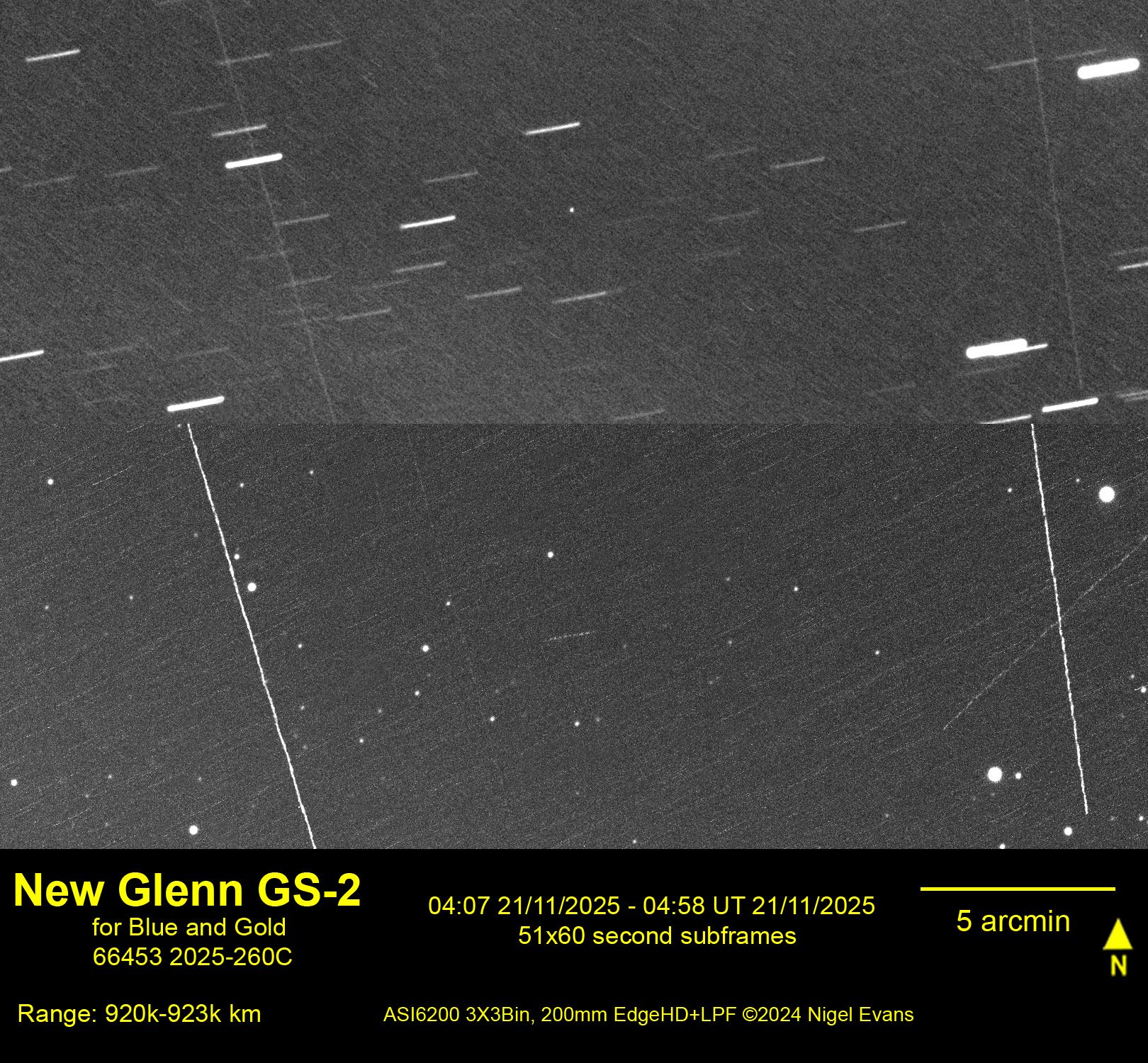
The launch vehicle, the New Glenn rocket, presents a much larger reflective profile than the satellites, and therefore appears much brighter. Each satellite is equipped with solar panels presenting a highly reflective area of approximately 8 m2. The upper stage of the launch vehicle is 7 m wide and 23.4 m tall, an area of 164 m2, and is painted white. I obtained predictions for the position of the upper stage. At a distance of 900k km and a predicted magnitude of 16.9, it would be at the limit of visibility in a 60 second exposure. The following image shows it barely detectable in the raw image, much more easily visible when images are aligned on the object and stacked.
The trail of the upper stage is uneven in brightness. The following video reveals why: the rocket is tumbling, with a period of around 5 minutes. I estimate the peak brightness to be magnitude 16.5.
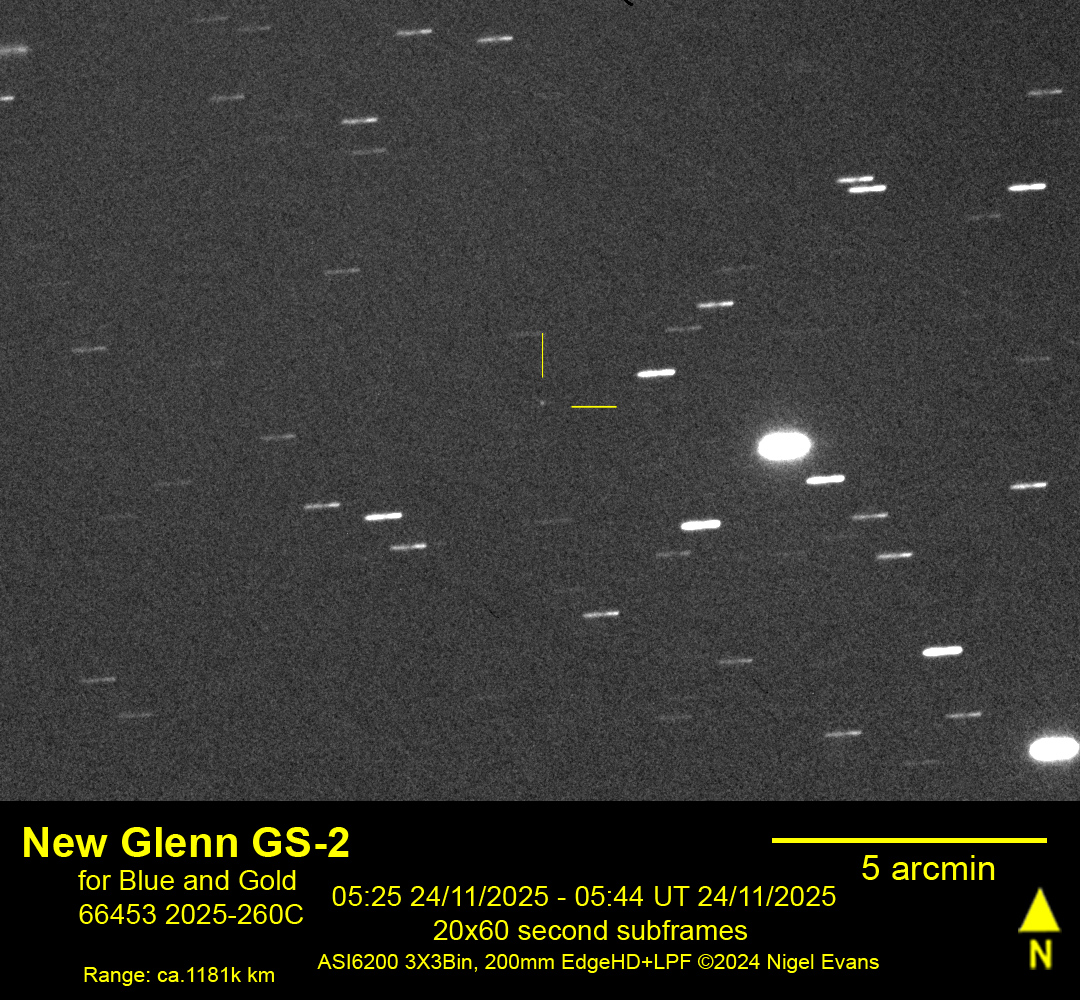
I imaged the upper stage again on 24 November, as it continued its departure from Earth. When imaged, it was at a distance of 1.2million km.
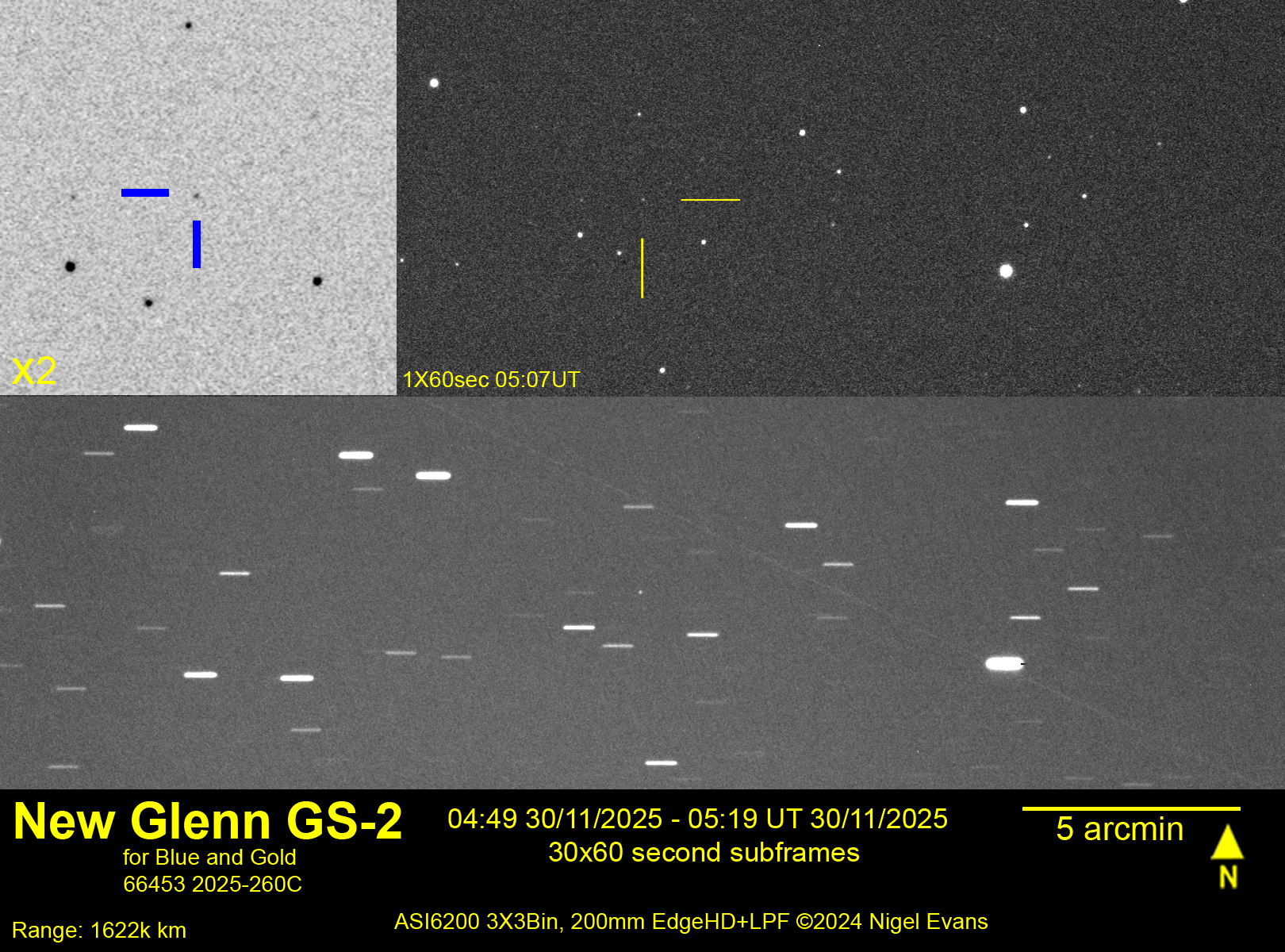
By 30 November, the upper stage was at a distance of 1.6 million km away (four times the distance of the Moon) and tumbling slowly. It was only occasionally visible in single frames and is visible below as a solitary dot when frames are stacked.
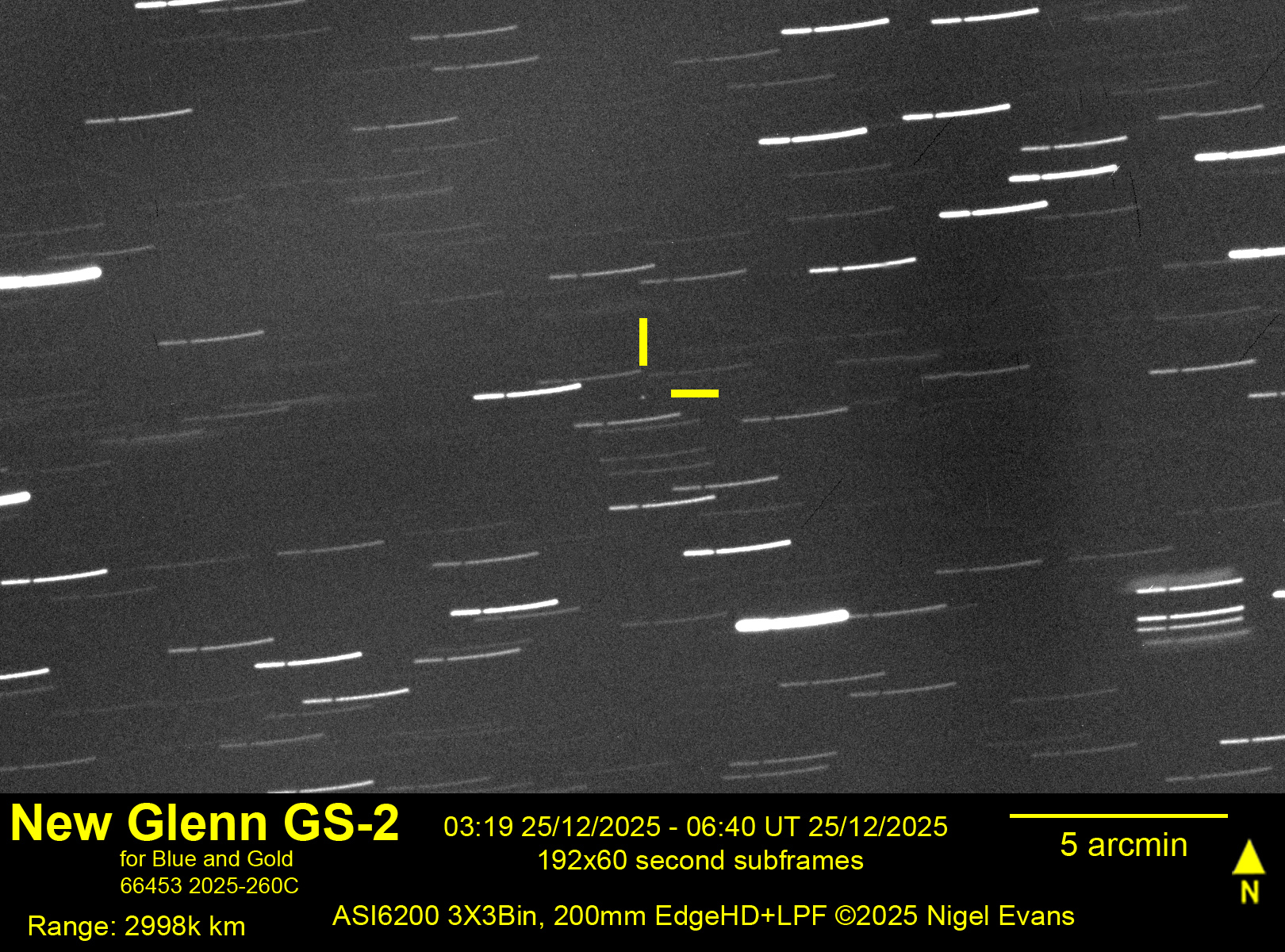
By 25 December, the upper stage was at an elongation of 90° and "easier" to image. At around magnitude 18, it is rather faint, and not visible in a single 60 s frame. The following image, a stack of 192 60 second frames, shows it clearly. The short gap in star trails is due to the telescope performing a meridian flip.
The upper stage is also visible in the following short video, based on stacks of thirty 60 s frames (this produces a better result than stacks of fifteen 60 s frames). When the video was taken, the object was at a distance of almost 3 million km.
Although the upper stage is still receding, its phase angle is decreasing, meaning that its brightness is increasing. It will reach opposition around 02 March 2026, close to the Full Moon as a magnitude 16 object.
Nigel Evans