Orwell Astronomical Society (Ipswich)
Asteroids, 07 January 2008 - 05 January 2026
This page records observations of asteroids, including near-Earth objects (NEOs), by members of OASI.
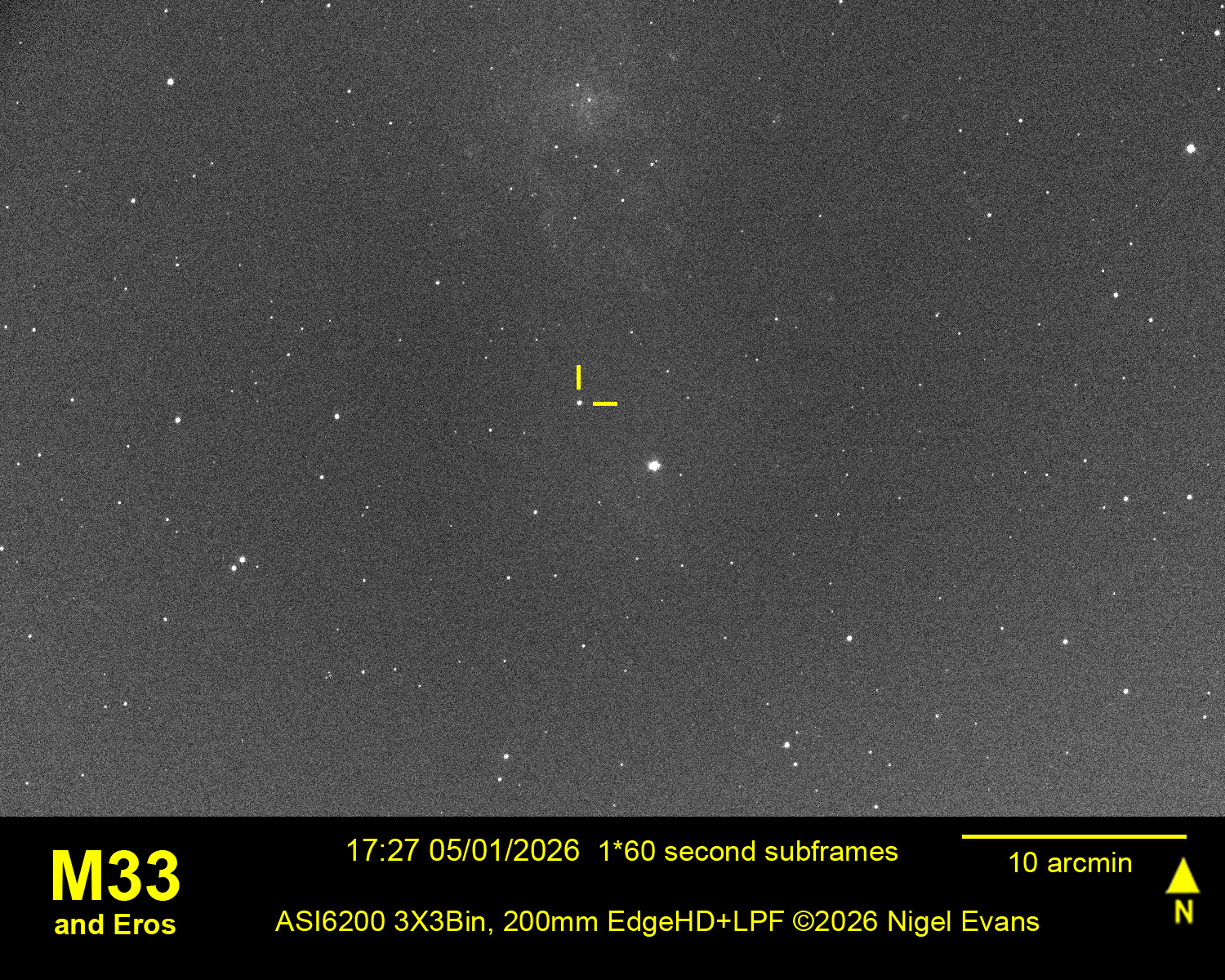
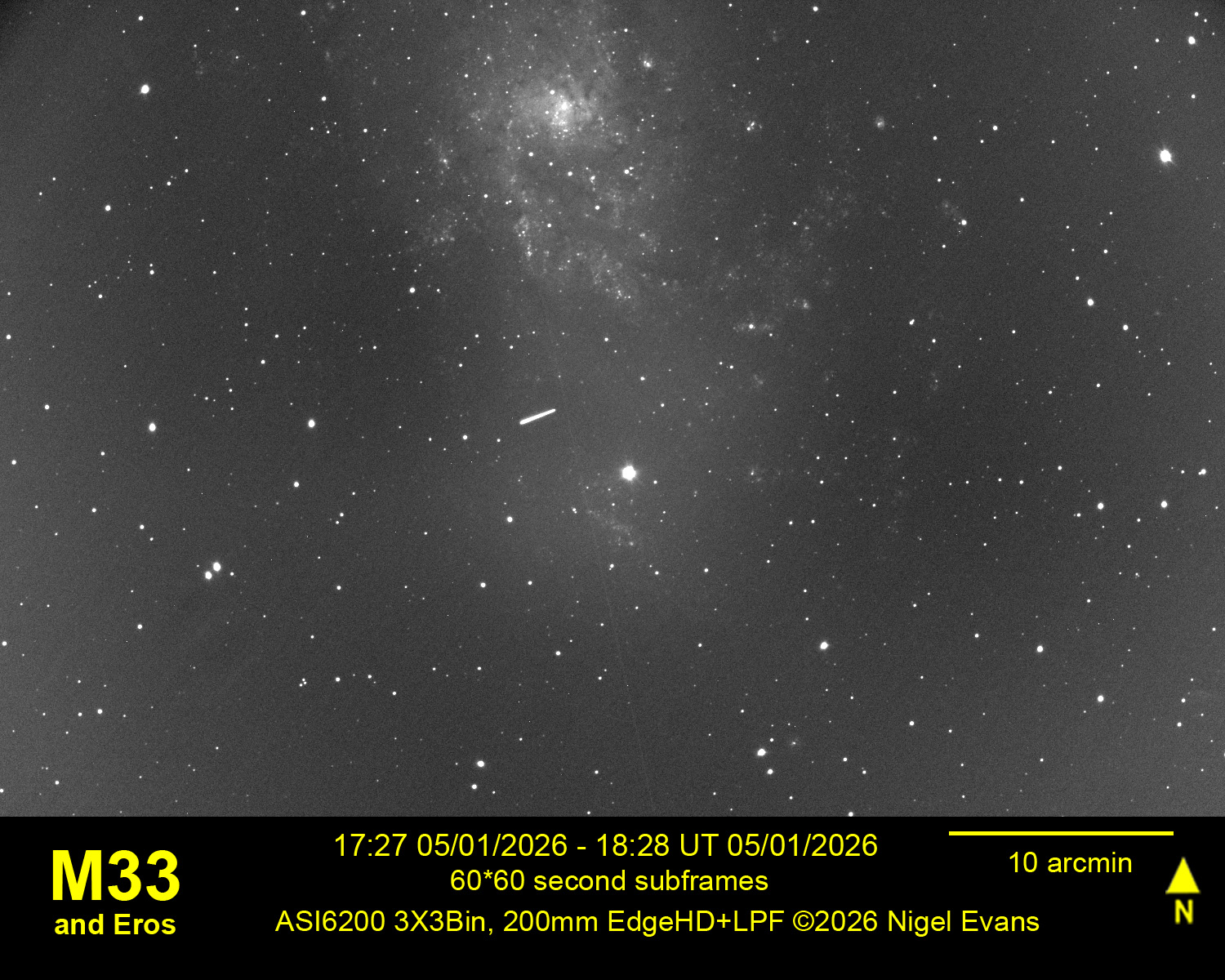
On 05 January 2026, asteroid 433 Eros (magnitude 10.8) swept past M33, the Triangulum Galaxy. I was alerted to the event by a piece on the BAA website. I started observing as soon as it was dark enough and followed Eros until its meridian crossing, at which point clouds rolled in!
A single 60 second exposure.
A stack of sixty 60 second exposures.
A brief movie showing the motion of Eros close to M33.
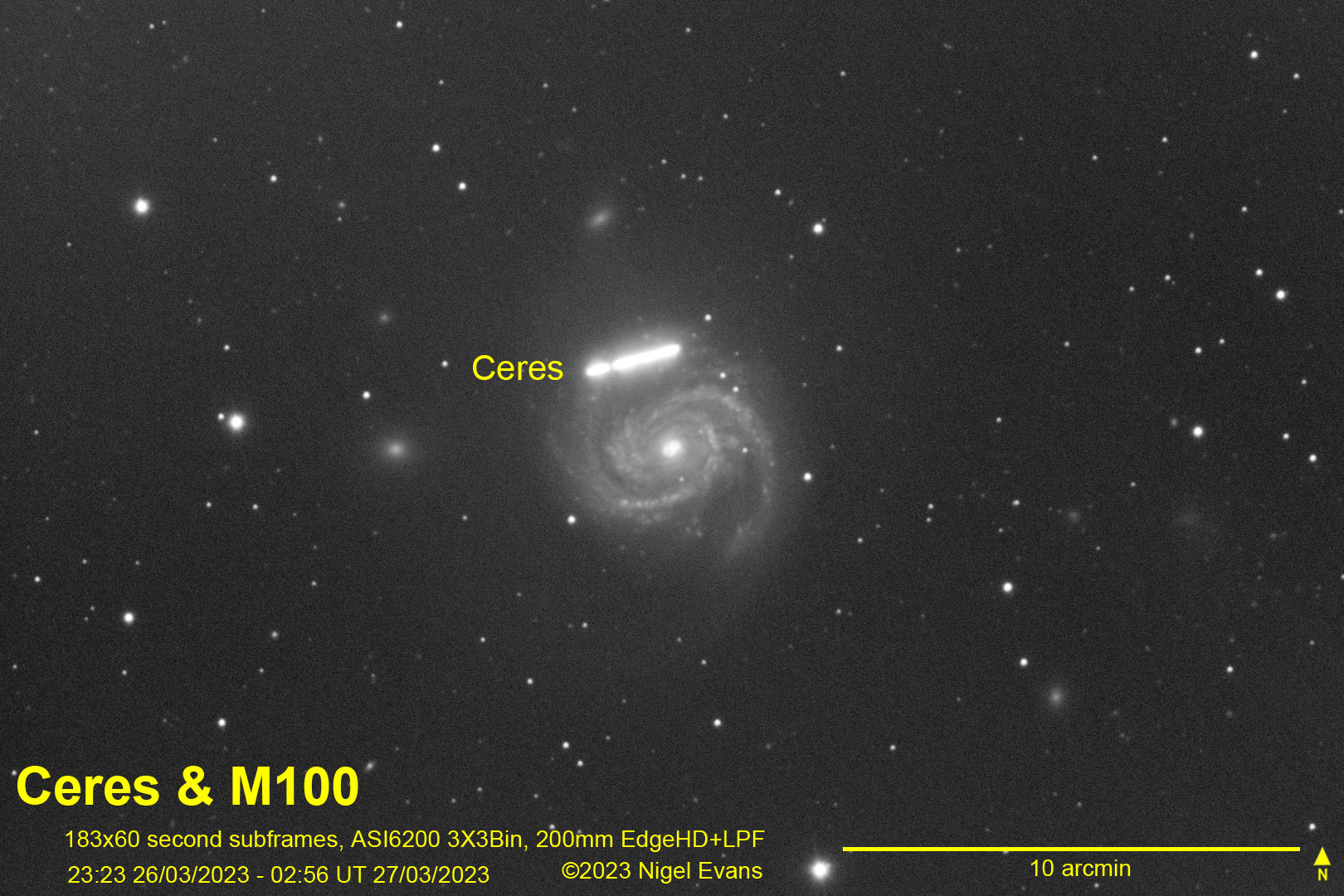
Astronomy magazines highlighted that Ceres, the largest dwarf planet, would pass in front of the galaxy M100 on the night of 26-27 March 2023, creating a photo opportunity.
Ceres moves through the sky at approximately half an arcsecond per minute, so the passage took several hours. At magnitude 7, Ceres could not be mistaken for a supernova, which would be around magnitude 15 or so.
The video shows the passage. Early evening cloud delayed the start of the video. Subsequent gaps are due to occasional cloud obscuring the view, and the need to perform a meridian flip of the telescope. The image below the video is a composite of the video frames.
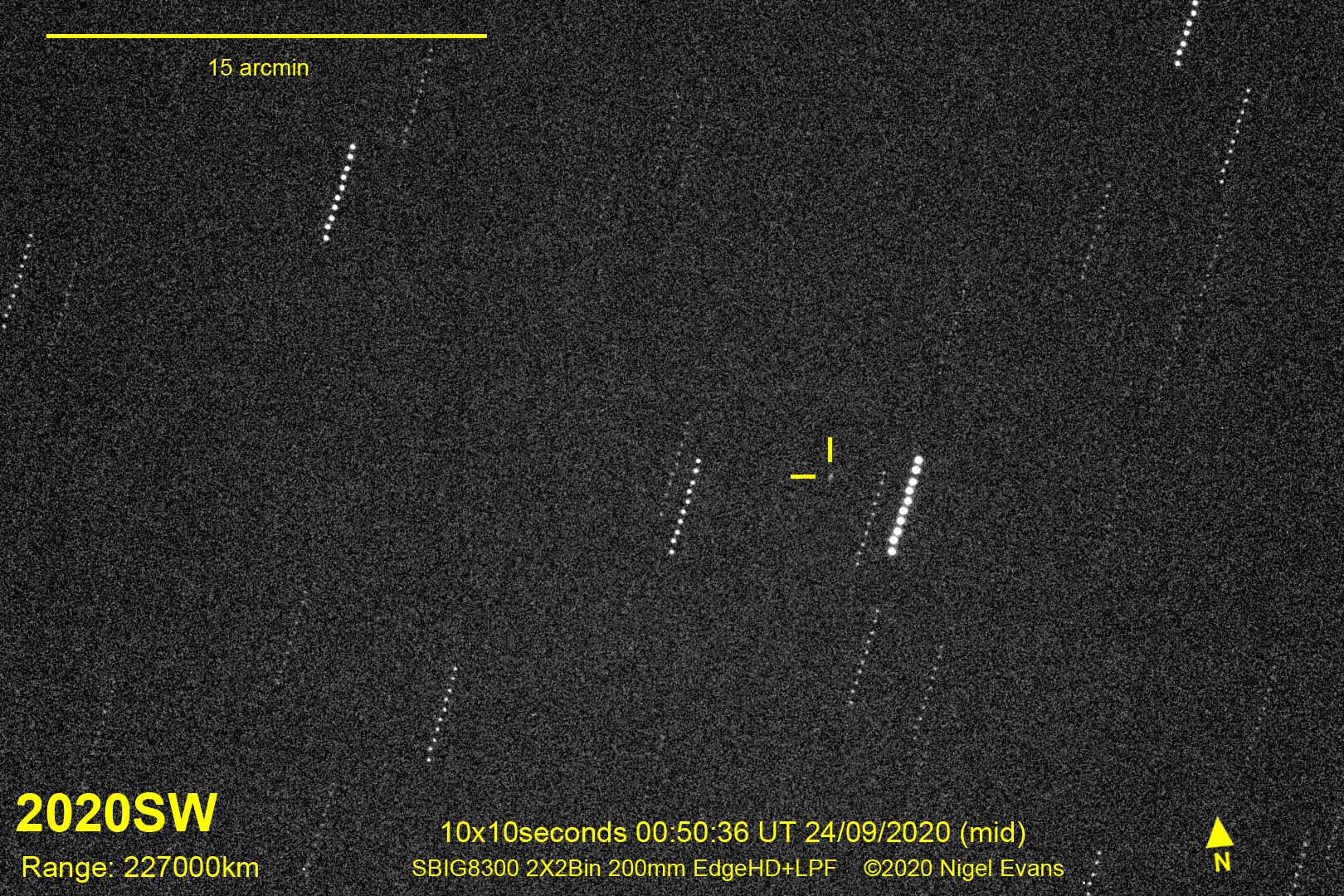
Near Earth Asteroid 2020SW was discovered on 18 September 2020 by the Catalina Sky Survey in Arizona. Its diameter was estimated at approximately 10 m. On the morning of 24 September, it passed only 28,000 km from the Earth.
The object was too faint to be recorded in a single frame so I had to apply some processing to make it visible. The following composite image is a stack of ten 10 s frames, offset relative to one another by the motion of 2020SW, then added. Because of the rapid motion of the object, all stars appear 10 times.
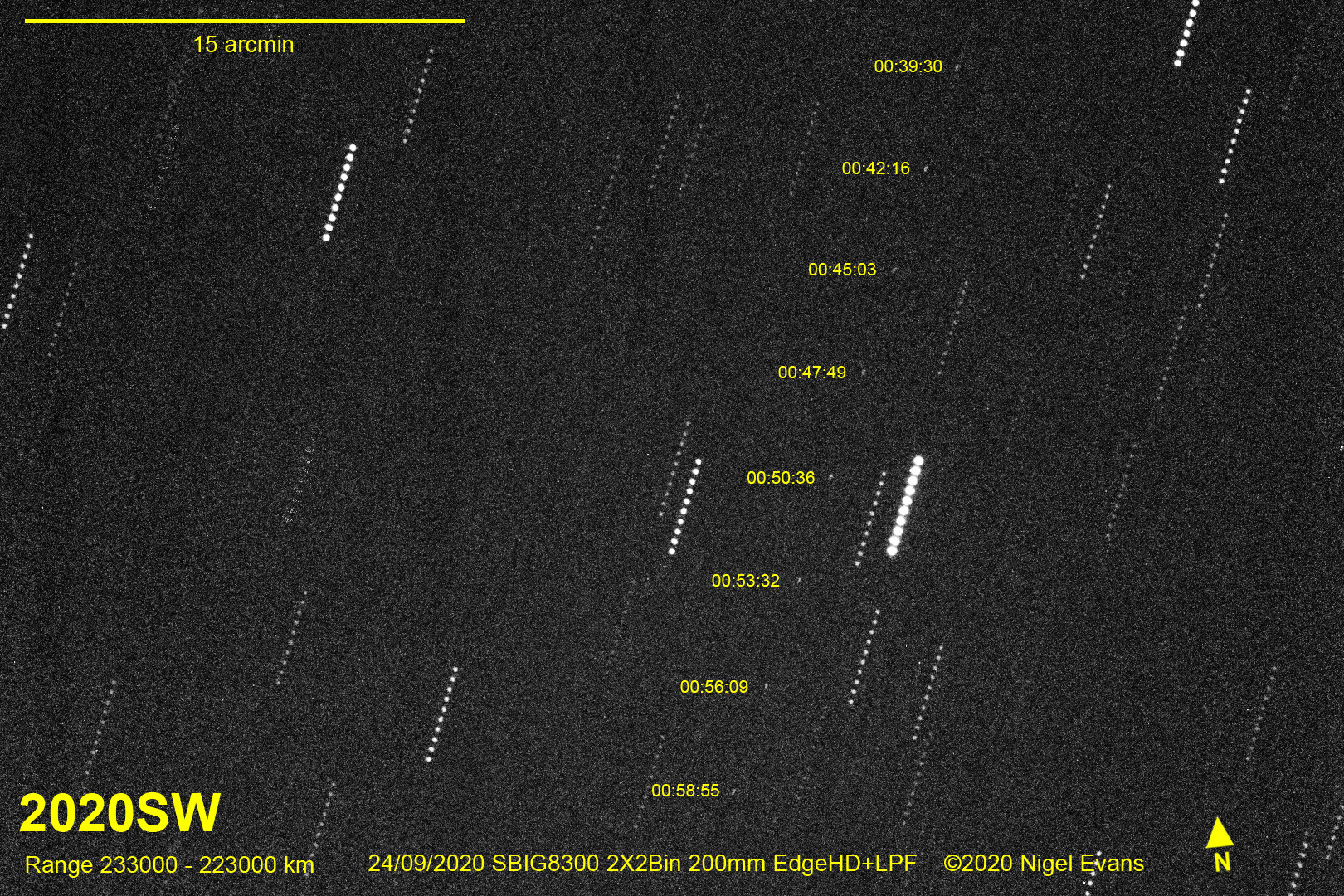
The following image is a stack of successive composite images, each produced as above. It captures the motion of 2020SW against the stellar background (while retaining multiple images of the stars).
The following movie clip shows:
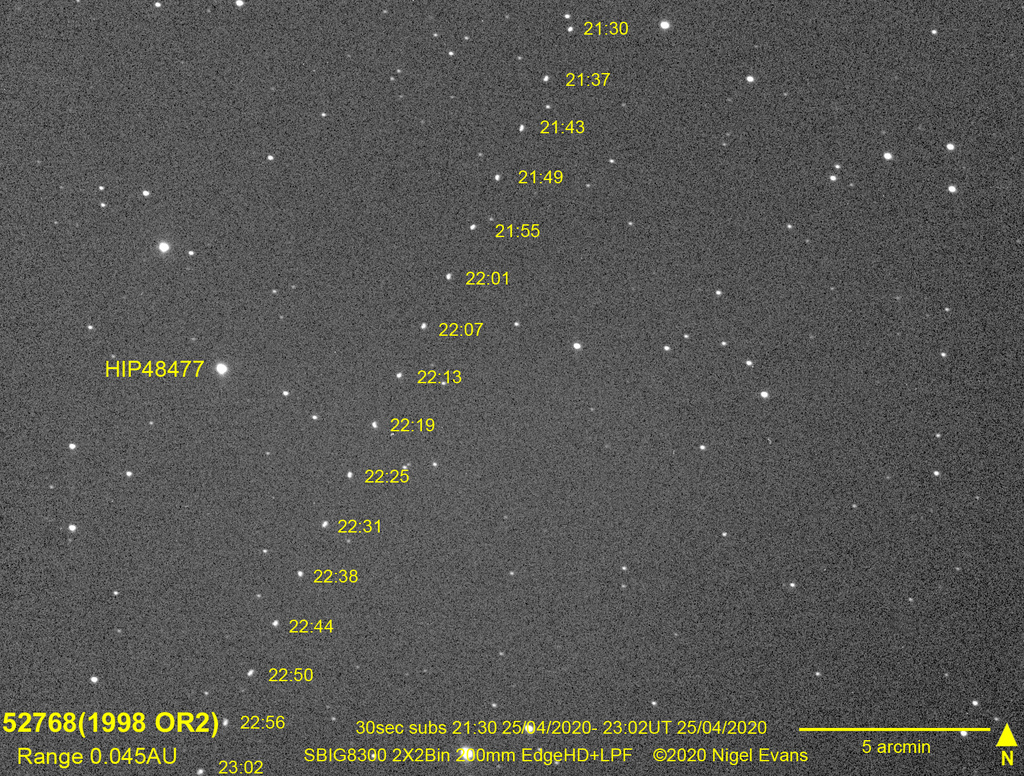
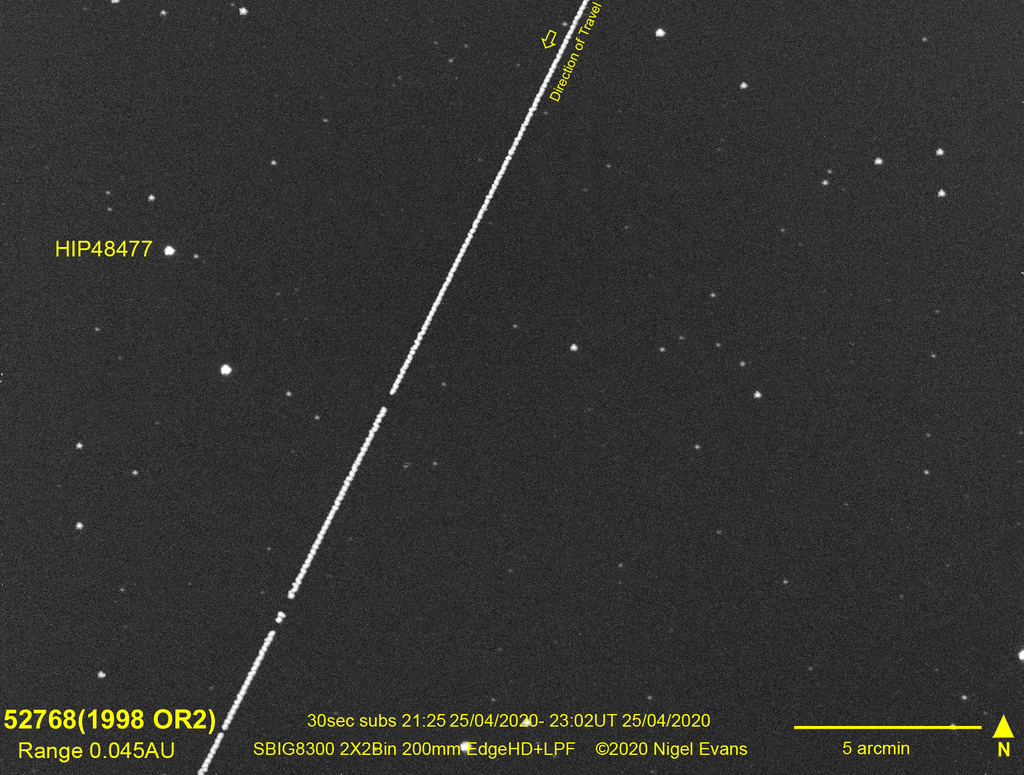
Near Earth asteroid (52768) 1998 OR2 passed about 6.3 million km from the Earth on 29 April 2020. The object is potentially hazardous on a timescale of thousands of years and is notable for its large size, at over 2 km diameter. On 25 April I imaged it in Sextans, at magnitude 11, moving south at over 14 arcminutes per hour (7 arcseconds in each 30 second exposure).
The attached animation shows the motion of the body. Occasionally it appears to vanish: that's when the guider lost control and the frame could not be used. The two stills present its motion in slightly different ways.
Asteroid 2023 DZ2 was discovered on 27 February 2023. The object is approximately 70 m in diameter and gained attention because, until its orbit was well established, there appeared to be a possibility that it might collide with the Earth on 14 February 2046. Thankfully, now that its orbit has been refined, it is clear that there is no danger of a collision in the near- to mid-future.
Less dramatically, 2023 DZ2 passed Earth on 25 March 2023 at a distance of 175,000 km. It was not visible from the UK on the date of closest approach, but was visible on the previous night, at a distance of some 600,000 km, at magnitude 14. Its angular velocity was 40 arcseconds/minute, requiring short exposures to arrest its motion.
The below image was created from a stack of frames following the asteroid. The elongated shape is due to motion blur rather than the shape of the body.
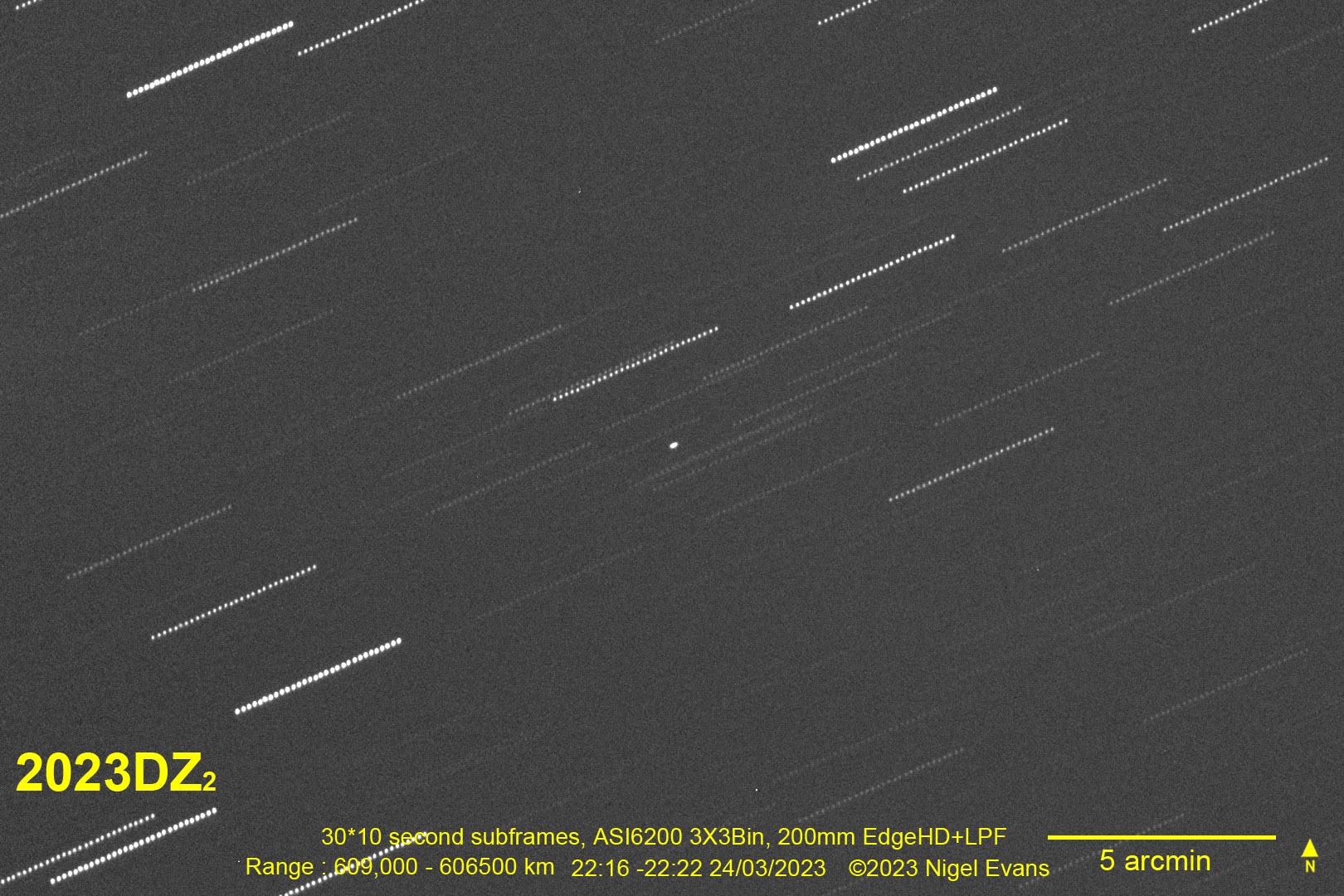
The following video initially shows the motion of the asteroid among the stars, then follows the asteroid, making the stars appear to move.
Asteroid 1981 Midas was discovered on 06 March 1973 by Charles Kowal at Palomar Observatory. It was named after King Midas from Greek mythology.
On 19 March 2018, the object appeared at magnitude 12, at a distance of 15m km, moving at 20 arcsec/minute at an altitude of around 80° (figures are approximate!) I captured the images below.
The following frame is a composite of approximately two hundred 10 s sub-frames. The stars appear faint in each frame and the motion of Midas looks slightly uneven, as if the exposures were not equally spaced.
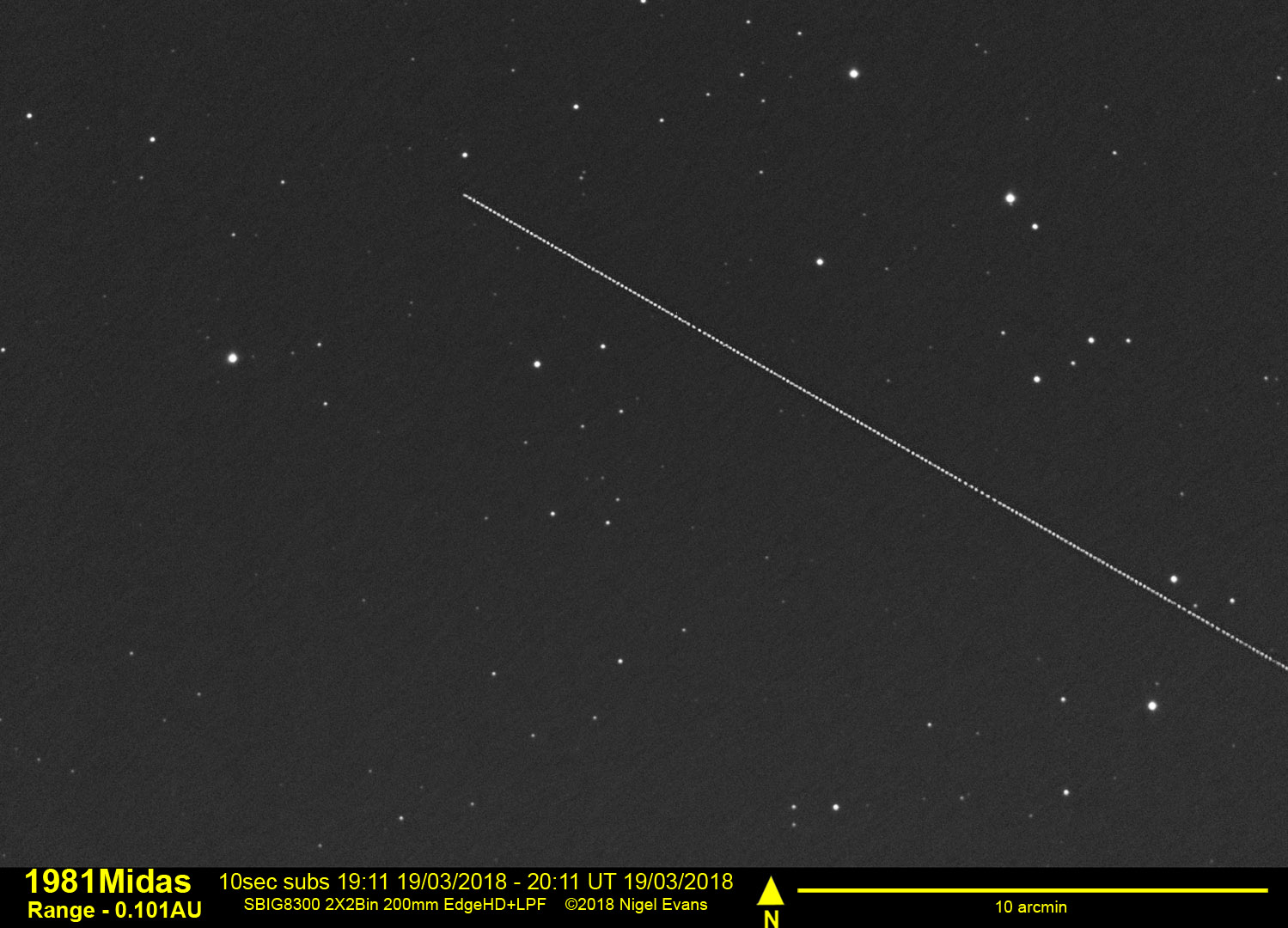 10 s frames.
The following frame is a composite of ten 180 s sub-frames: this time the stars appear much stronger but the auto-guider was following a faint star with a 3 s integration time resulting in a crinkly appearance to the motion of Midas.
180 s frames.
Midas will remain visible for several days more, with closest approach on the evening of 21 March 2018.
Professional astronomers discovered the asteroid designated 2017 VR12 on 10 November 2017, using the 150 cm Pan-STARRS 1 telescope in Hawaii. The body is estimated to be approximately 265 m in diameter and, because it has the potential to make close approaches to Earth and is big enough to cause significant regional damage if it were to strike, is classified as a potentially hazardous object.
On 07 March 2018, 2017 VR12 passed Earth at approximately 1.5m km (almost four times the distance of the Moon). The object was closest to Earth at around 07:53 UT. I captured the following video of its motion, using a Celestron C8 telescope and SBIG8300 camera.
3200 Phaethon is an Apollo asteroid, with an orbit that brings it closer to the Sun than any other named asteroid, at a perihelion distance of only 21 million km (although numerous unnamed asteroids come closer). It is the parent body of the Geminids meteor shower, which occurs annually in mid-December.
At 23:00 UT on 16 December 2017, Phaethon passed a mere 10,312,040 km from Earth, moving at an apparent velocity of 38 arcsec per minute. It was visible in small telescopes, at brightest shining at magnitude 10.8. It will not make an approach closer to Earth until 2093, when it will pass at a distance of 2,964,000 km.
I captured the following video of the passage, from 21:03-21:56 UT. The slightly wiggly track is an artefact of the autoguider.
An article in Astronomy Now highlighted a close passage of NEO 2003 YT1 to Polaris on 01-02 November. The sky was clear so I captured images with static cameras.
I used a Canon 60Da camera at ISO 800 coupled to a Megrez 90 mm, f/5.2 refractor on an HEQ5 mount to record 341 still images during the period 23:59:47 - 02:58:42 (UT). Each image was of duration 28 s and consecutive images were separated by a gap of 2 s. The video below shows two sequences produced from the images. The first is a movie formed from all 341 stills. To create the second, I combined 10 frames to make trailing more visible then advanced three frames and repeated the process, i.e. I combined frames 1-10, 4-13, 7-16 and so on, creating 111 images in all.
I also captured images with a Canon 50D with a 50 mm, f/4 telephoto lens, but these were not so impressive. I attempted to capture images with a 200 mm, f/10 Celestron Edge HD Schmidt-Cassegrain instrument. Unfortunately, the very small field of view of some 10 arcminutes made the task of finding the NEA very difficult and I was unsuccessful.
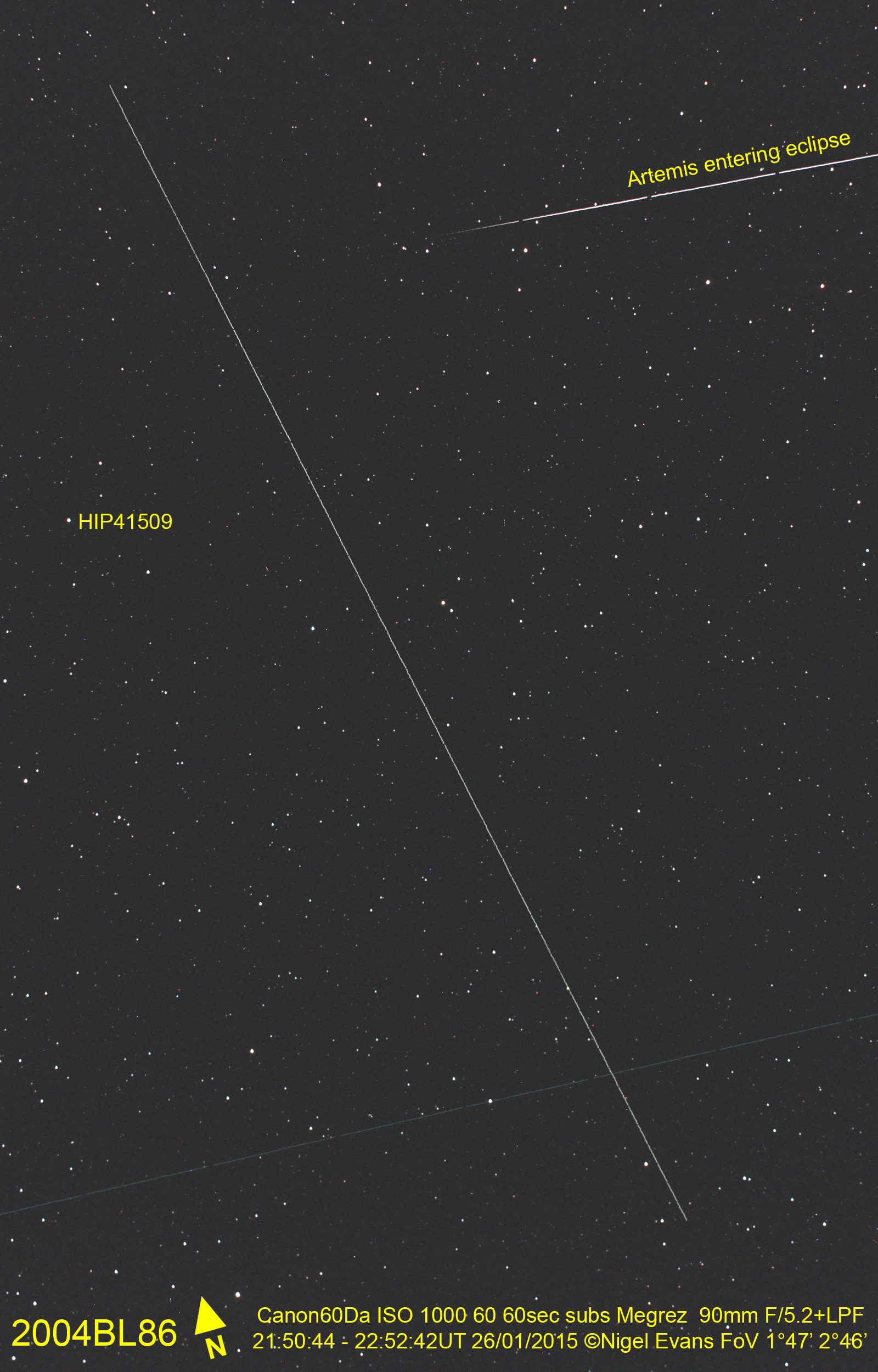
Asteroid 2004 BL86, officially classified as a Near Earth Object (NEO), was discovered on 30 January 2004 by a telescope of the Lincoln Near-Earth Asteroid Research (LINEAR) survey in White Sands, New Mexico. On 26 January 2015, it passed within 1.2 million km of the Earth (roughly three times the distance of the Moon). Astronomers estimate that the asteroid is about 0.5 km in diameter and that no other asteroid of comparable size will approach so close to the Earth until the object 1999AN10 in 2027.
At its closest approach to Earth, 2004 BL86 appeared as a magnitude 9.0 object moving through the sky at a speed of 2.5° per hour. It thus became an interesting object for amateurs to observe.
I used a William Optics Megrez 90 APO refractor at F5.2 with low pass filter together with a Canon 60Da camera at ISO 1000 to capture a sequence of images of the object as follows. On the LHS is a movie showing a sequence of 60 images, each of 60 seconds duration, spanning the period 21:50:44 - 22:52:42 UT. On the RHS is a stack of the 60 frames.
The track of 2004 BL86 is from bottom right to top left. Running from top right to top left is the track of asteroid 105 Artemis, entering eclipse and becoming invisible. The track from lower right to lower left is created by an unidentified geostationary satellite.
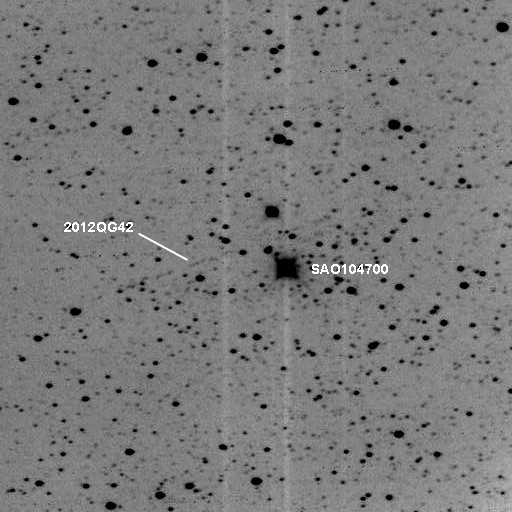
On the night of 13 September 2012, the recently-discovered asteroid (and NEO) 2012 QG42 came closest to Earth in its orbit, at a distance of approximately 2.8 million kilometres. The object was slightly fainter than magnitude 14 (similar to Pluto) and moving at 48 arcminutes per hour. I used my 30 cm reflector, now working at F/4.1, with a Starlight Xpress H16 CCD, giving a field of 42 arcmin square. The observation was challenging because, due to its speed of motion, the asteroid spent just three seconds on each pixel of the CCD, providing minimal time to collect photons.
I captured twelve images between 21.56 and 22.08 UT, each of duration 30 seconds, and stacked them to produce the image below. It is 21 arcmin square with north up and west to the right. During the 12 minute imaging time, the asteroid moved 10 arcmin (at position angle 285°) i.e. about half the width of the field. It appeared brighter at the start than the finish so maybe it has an irregular shape and is rotating? The image isn’t particularly good, but I was pleased to record anything at all!
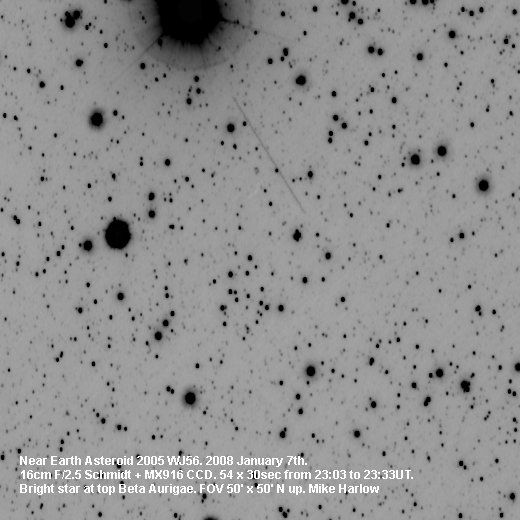
While looking at SpaceWeather.com on the night of 07 January 2008, I noticed a prediction of a close approach of asteroid 2005 WJ56 on 10 January 2008. (The body is classed an NEO, or near earth object and was predicted to pass within 11 times the distance of the Moon.)
I downloaded the orbital elements from the Minor Planets Centre and loaded them into my Guide planetarium software. This showed that 2005 WJ56 was close to β Aurigae and thus easy to find. So I went out to take some images. By the time I was ready to start imaging, the asteroid was right on top of the star and I had to wait about 15 minutes for it to emerge from the glare of the latter. However I soon picked it up and then took a sequence of 54 thirty-second exposures from 23:03 to 23:33 UT. Each new exposure showed the movement of the asteroid and an animation of the images shows its rapid motion against the background stars. The image below, obtained by stacking all the exposures, shows the motion of the asteroid in 30 minutes as a trail.