Orwell Astronomical Society (Ipswich)
Comet 2026 A1 (MAPS)
Comet MAPS, officially C/2026 A1 (MAPS), was discovered on 13 January 2026 by the collaboration of French astronomers Alain Maury, Georges Attard, Daniel Parrott and Florian Signoret, working at the AMACS1 Observatory in the Atacama Desert, Chile. The name of the discovery team, and that of the comet, come from the initial letters of the family names.
The comet was a highly unusual type known as a sungrazer. As the name suggests, sungrazing comets pass extremely close to the Sun and, in consequence, can be very bright, but move very fast, and are often visible for only a few days or, possibly, even hours. Previous bright sungrazing comets included C/2011 W3 (Lovejoy) in 2011 and C/1965 S1 (Ikeya-Seki) in 1965. A couple of hours before perihelion (closest approach to the Sun), Ikeya-Seki was estimated to be as bright as the first quarter Moon (magnitude -10); the next day, its brilliance had diminished to that of Venus (magnitude -4).
I used Dominic Ford’s "in-the-sky" website to produce ephemerides (tables of predictions) for Comet MAPS for the period 20 March - 13 April, and hourly throughout 04 April. (The ephemerides are available here.) Although it is notoriously difficult to predict the brightness of a comet, the ephemerides raised hopes that MAPS might be visible to the naked eye around the time of perihelion. I recommended observers to search for the comet by holding a hand up towards the Sun to shield the eyes from direct sunlight while looking to the right of the palm (before perihelion) or left (after perihelion). Telescopic observations with the comet near the Sun were not advised due to the danger of the instrument being knocked and pointing directly at the Sun, or of off-axis heat from the Sun causing damage to the interior of the telescope tube.
For observers preferring an on-line experience, images from the LASCO coronographs aboard the SOHO spacecraft were available via the SOHO website or smartphone app. (SOHO is the the Solar and Heliospheric Observatory, a joint NASA/ESA spacecraft launched in December 1995. LASCO is the Large Angle and Spectrometric COronagraph, one of 11 instruments carried; it is a set of three coronographs which image the solar corona from 1.1 to 32 solar radii, i.e. 800,000-22,500,000 km.)
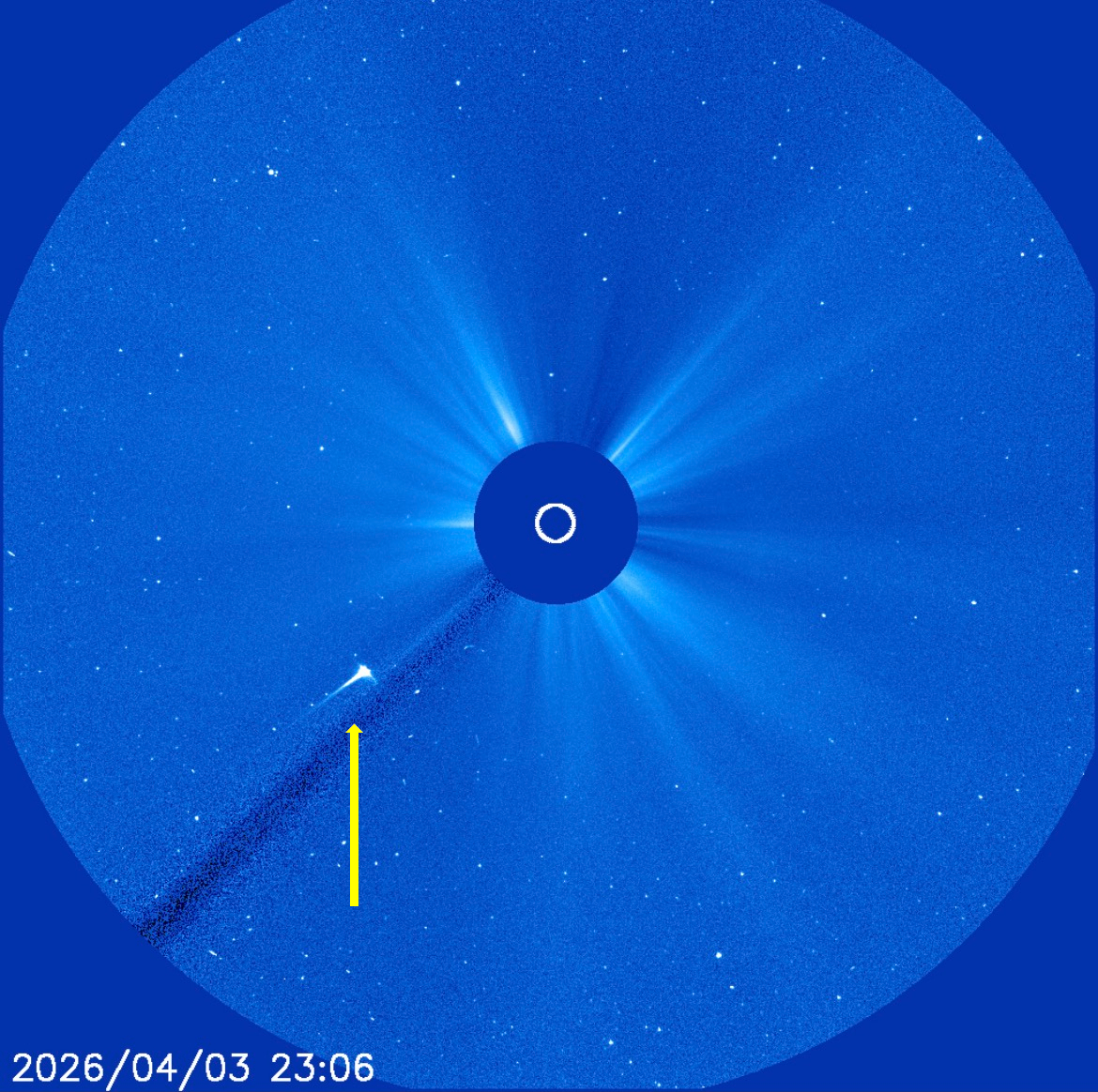
The comet reached perihelion at 14:17 UT on 04 April 2026, at a distance of only 163,000 km above the photosphere. The below image from the LASCO C3 coronograph, taken at 23:06 UT on 03 April, shows the comet on approach to perihelion. In the image, the comet appears at magnitude circa -2, brighter than Saturn (magnitude 0.9, the planet has just left the field of view of the coronograph following solar conjunction), but not as bright as Venus (magnitude -3.9).
Weather in the UK before perihelion was not favourable, and the magnitude of the comet was broadly in line with predictions. No naked eye observations were reported in the UK before perihelion. At perihelion, the comet received approximately 41.8 MW/m2 of energy from the Sun. Alas, the comet did not emerge from perihelion, and it appears that the solar energy density was sufficient to vapourise it.
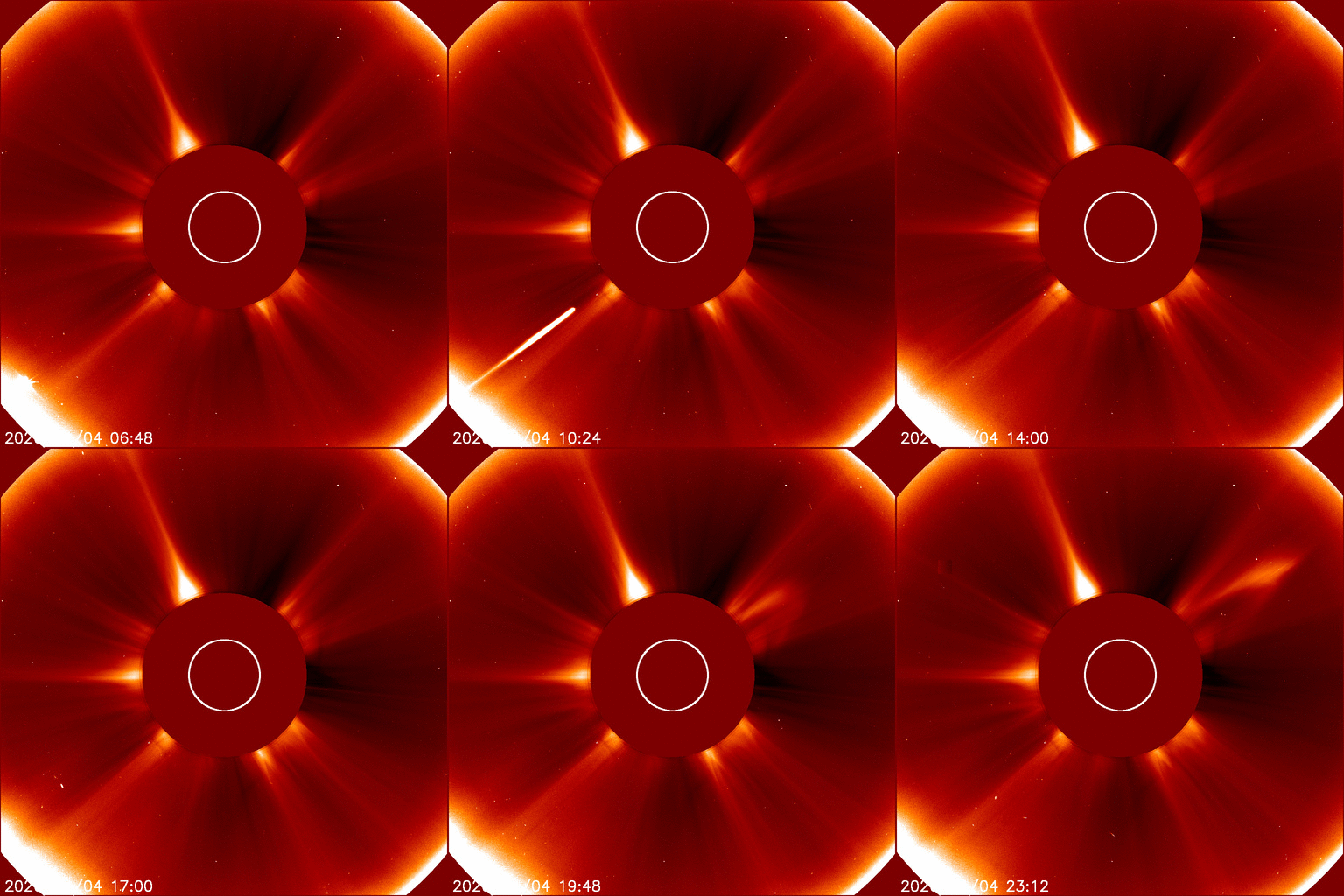
Nick James (Director, BAA Comet Section) produced the below video from 74 images captured by the LASCO C2 instrument, showing the comet on final approach to perihelion. (Note the differing image scales of the C2 and C3 coronographs.) It spans the time period 06:48-23:12 UT on 04 April. (The video is reproduced with permission.)
Bill Barton, FRAS