Orwell Astronomical Society (Ipswich)
Falcon 9 Stage 2025-010D and Lunar Landers, 01 February 2025 - 12 May 2026
On 15 January 2025, a Space X Falcon 9 rocket launched two lunar landers on differing low-energy trajectories:
By early February 2025, both probes and the upper stage of the launch vehicle (designated 2025-010D) were in highly eccentric orbits of period circa>10 days. Their distances from Earth varied between 200 km and 350,000 km. At furthest point in their orbits, the objects were more distant than the Moon. Such an orbit is very unusual for the second stage of a launch vehicle: usually a booster is arranged to re-enter the atmosphere within hours of launch and burn up, or is flung into a heliocentric orbit.
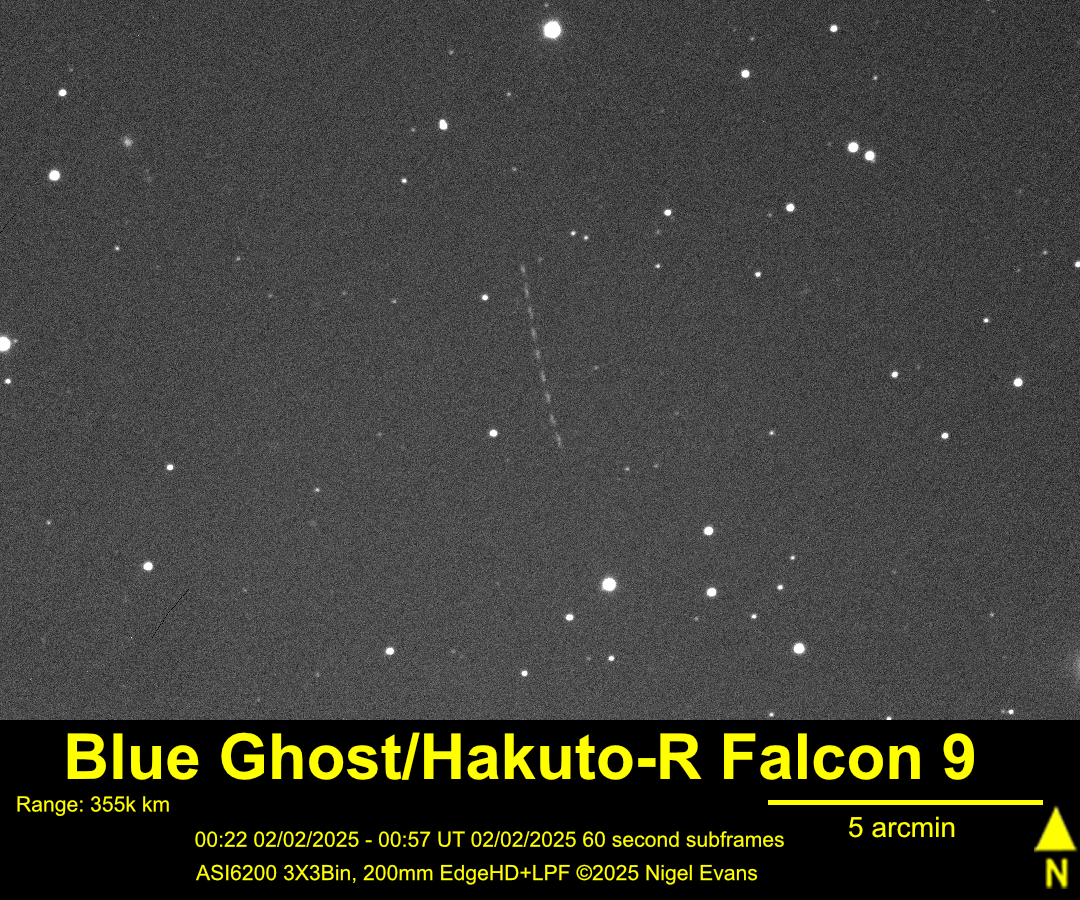
On 01 February, I was able to capture Blue Ghost and 2025-010D in separate fields. Hakuto was too faint for me. Blue Ghost was challenging as it was moving at approximately 0.4 arcsecond per second, limiting the exposure time. I took 600 ten-second frames. The second stage of the Falcon 9 was tumbling with a period of about 4 minutes.
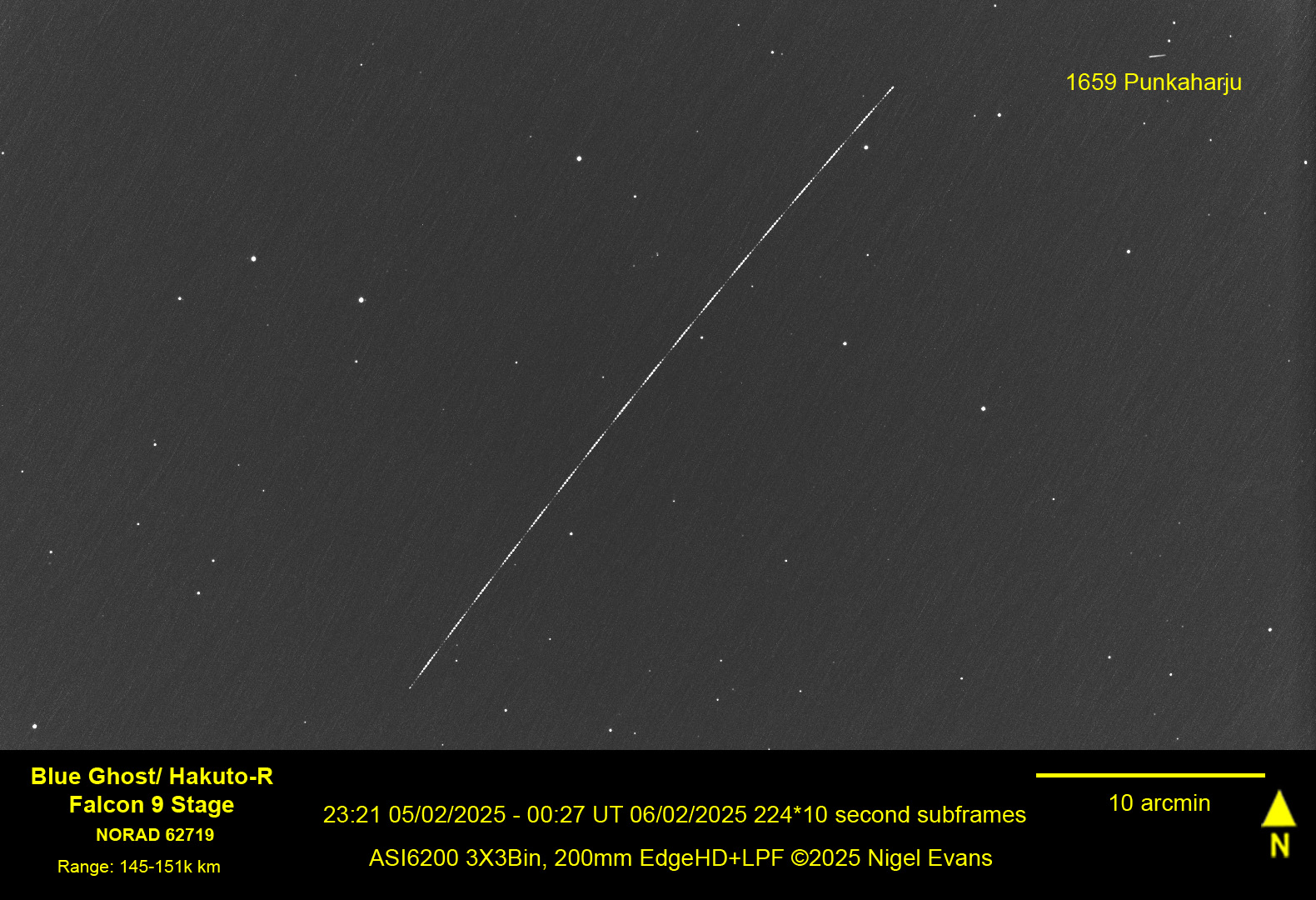
Another opportunity to observe 2025-010D occurred on 05 February, when it was at a distance of 165,000 km. Predictions from projectPluto.com indicated that the object would be visible at magnitude 12 but moving quickly at some 0.5 arcsecond per second. I took a series of 10 second exposures and found the object to vary in brightness between magnitudes 12 and 15 with a period of 238 seconds (slightly shorter than during the earlier observation).
Both lunar landers reached the Moon, Blue Ghost enjoying a soft landing but Hakuto suffering a systems failure and crashing onto the lunar surface. By May 2026, predictions indicated that 2025-010D would also crash onto the lunar surface. Impact was predicted for 05 August of the year, unfortunately, just beyond the sunlit limb.
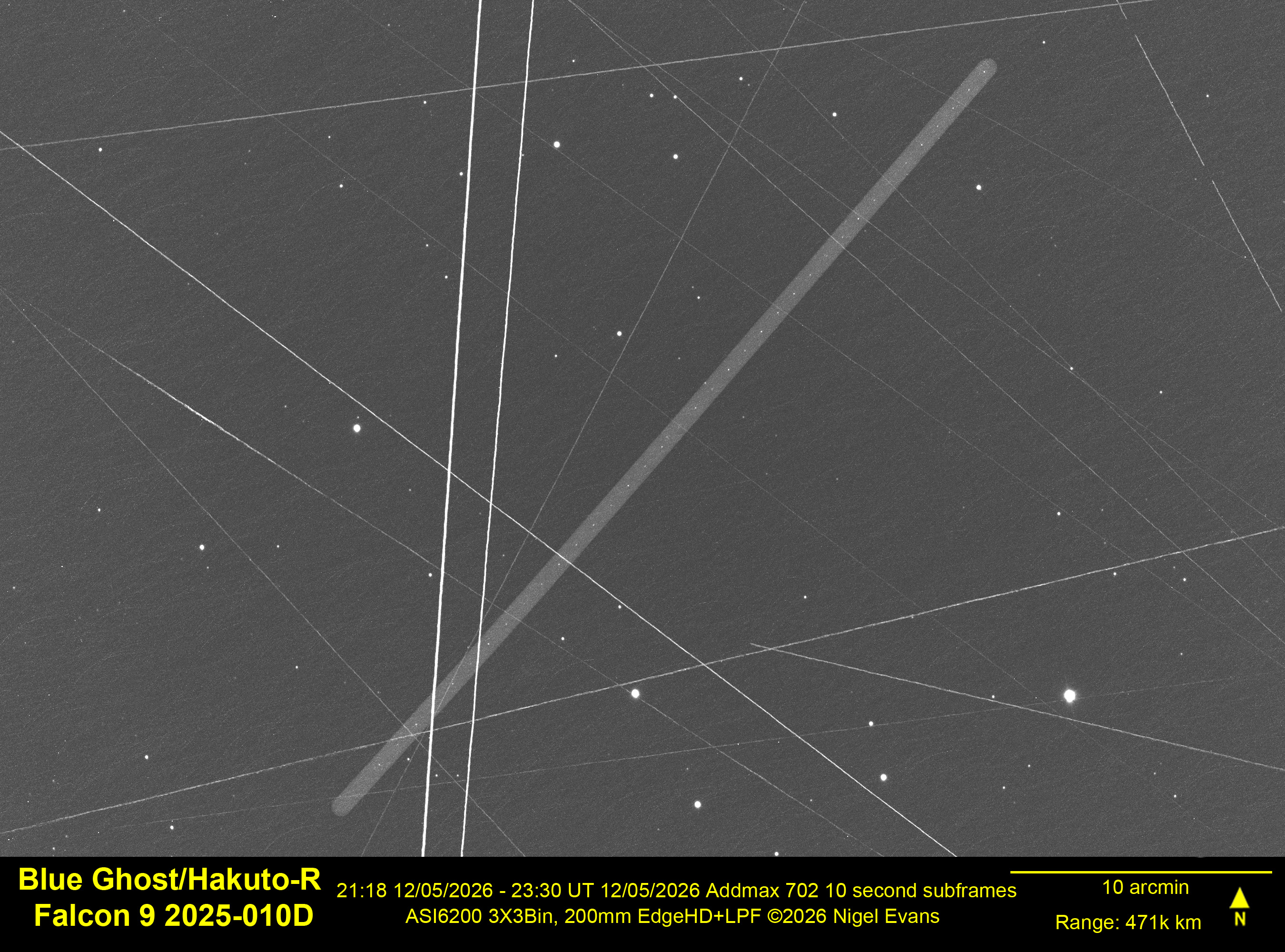
On 12 May, 2025-010D was favourably placed to image again. An image from Grant Privett two days earlier showed the object to be tumbling, with a very pronounced periodic flare. Due to its motion, exposures were limited to 10 seconds duration, providing a limiting magnitude of about 17.0. I captured 702 x 10-second frames. In the majority, the rocket was invisible. However, on stepping through them one at a time, I could see a flare every 18 or 19 frames, on average every 18.21 frames, corresponding to a period of about 3.45 minutes.
In an Addmax view of the 702 frames, the flares should show up as a straight row of dots. However, it was completely impossible to see them due to a blizzard of random hot pixels! It was a very tedious process to remove the latter, while leaving the faint background stars in the frames. in the following image, the line of bright flares caused by the tumbling booster is highlighted amongst a dozen or more satellite trails.
To show the variability more clearly I stacked the frames, grouping them by "phase" relative to the frames showing the flares. This provided 18 groups, each of 38 frames (with a few left over). The images in each group could then be added, either to show the booster or the stars as static. Results are shown below, as a movie (shown five times) and as an animated gif on infinite loop.
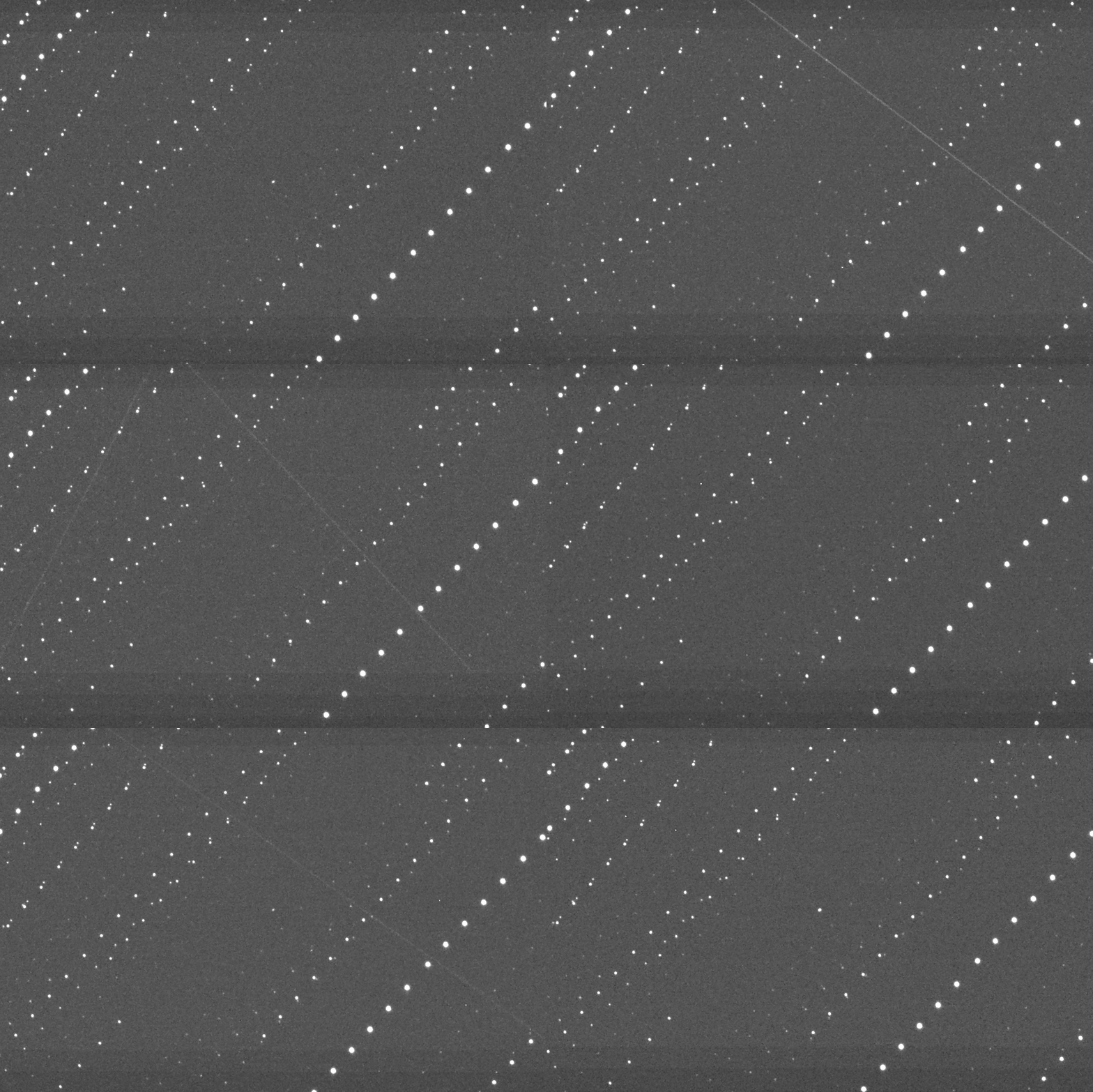
The peak magnitude of the booster is about 15.3, but this rapidly drops to 17 and below, at faintest being 17.9! So it's not surprising that it is largely invisible in most single frames!
Nigel Evans